The myth of ‘more Is better’
Accuracy doesn’t come from the sheer quantity of points. It comes from quality and, crucially, from a verified reference to measure against. Without that, all you’ve got is noise dressed up as progress.
Jump to Section:
Sign up for updates

More points do not equal more accuracy
In this industry, it’s easy to get dazzled by tech-speak – “higher data density”, “millions of points per scan,” “refined 3D models.” Some volume scanner manufacturers lean on these claims as if more points automatically equal better accuracy. It sounds impressive. But it isn’t correct.
Accuracy doesn’t come from the sheer quantity of points. It comes from quality and, crucially, from a verified reference to measure against. Without that, all you’ve got is noise dressed up as progress.
Stereo camera systems are a good example. They churn out massive point clouds, far bigger than LiDAR systems. But here’s the catch: every point is a guess. Cameras don’t measure distance directly — they infer it. The 3D model they spit out is only as good as the software that interprets it. If the assumptions are off, the numbers are wrong. In that case, a bigger point cloud just means more points that are wrong.
Loadscan doesn’t play that game. Our dual 2D LiDAR scanners measure distance directly, without guesswork. Every point is real, grounded in geometry, and benchmarked against a verified reference scan. That’s why independent tests prove Loadscan delivers accuracy within +/-1%. This is not a theory, but is used and proven in quarries, mines, and civil projects all over the world.
Accuracy comes from reference, not volume
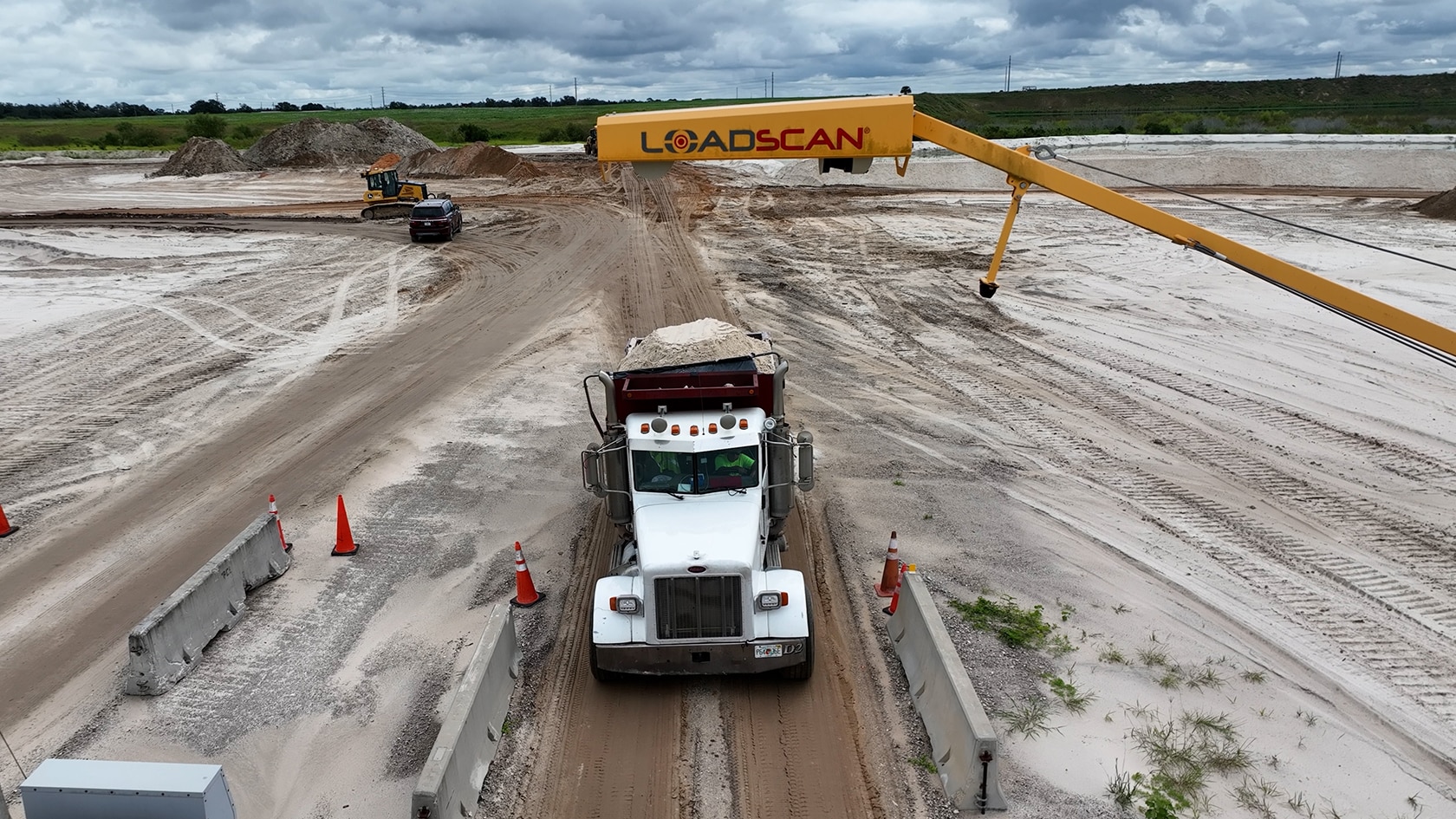
A true measurement system has to start with a trusted baseline. In Loadscan’s case, that’s an empty truck profile that is scanned into the system and stored as a baseline reference of that actual truck (or trailer) before the first load ever goes under the scanner. Every subsequent load is then compared back to that reference scan. If that isn’t precise, every step that follows is flawed, no matter how much data is collected. More points on a bad baseline just mean mistakes with greater details.
This is where Loadscan pulls clear of the pack. Our scanners lock in a detailed reference scan and then measure every load against it. The result? Repeatable, auditable, accurate data you can stand behind, no matter the industry you’re in.
Cutting through the marketing smoke
Competitors love buzzwords: “multi-stream processing,” “depth refinement,” “labelled point clouds.” But jargon can’t cover the fact that their accuracy isn’t independently proven. Operators don’t need fancy terms; they need results they can trust. In industries where production reports, invoicing, and compliance depend on those numbers, “close enough” is nowhere near good enough.
Proven in the field, not just the lab
Camera systems often look good in controlled tests. Put them in the real world — dust, rain, glare, vibration – and the cracks show. LiDAR doesn’t flinch. Day in, day out, it delivers consistent scans that hold up under scrutiny. That’s why Loadscan remains the trusted standard, with systems running on mines, in quarries and on construction sites around the world.
The benchmark hasn’t moved
Some manufacturers pitch “next-gen” systems that promise to outdo everything else with more data points. But measurement isn’t about who can collect the most – it’s about who can prove their numbers and use the data accurately. Loadscan has been doing that for decades, and our accuracy is internationally certified.
Loadscan doesn’t just gather data. It delivers truth. And, in industries where tonnes of material equal millions of dollars, that’s the only measure that matters.

More from this series
- Faster Isn’t Always Better | Volume 1, The Intelligence Series
- The myth of “more is better” | Volume 2, The Intelligence Series
- Why reference scans still matter | Volume 3, The Intelligence Series
- LiDAR: Still setting the standard in load volume measurement | Volume 4, The Intelligence Series
- Heavy-duty vs lightweight: Why Loadscan is built to last | Volume 5, The Intelligence Series
- When “fast” becomes a liability | Volume 6, The Intelligence Series